
Smart Home · Herford
Your home thinks smart too.
Control lighting, shutters, heating and security from one place, instead of juggling ten apps. We plan smart home technology that suits your house, manufacturer-neutral and without gadget overkill.
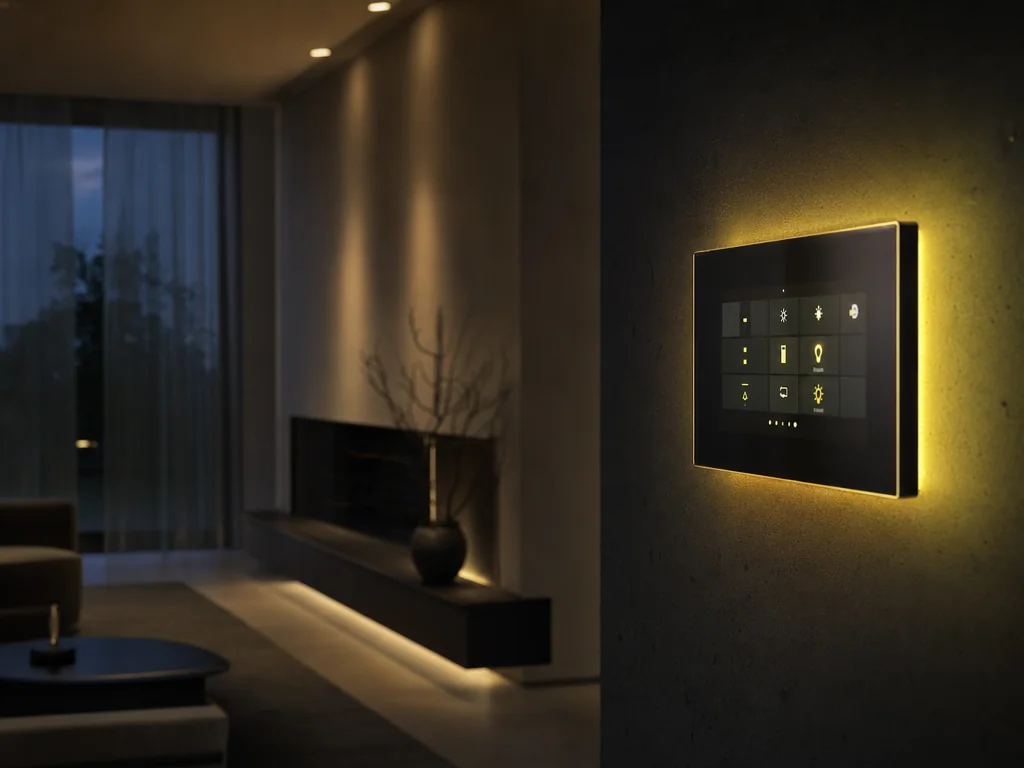
- What does a smart home control at my place?
- Usually lighting, shutters or awnings, the heating and individual sockets. Everything can be operated individually or bundled into scenes, such as "Leaving home" or "Cinema".
- Can it be retrofitted, or only installed in new builds?
- Both. In existing properties we mostly work with wireless technology that needs no new cabling. For new builds or a full renovation, the wired KNX bus is the better fit.
- Am I tied to certain manufacturers?
- No, not to any particular one. We plan manufacturer-neutral, including with Gira, Busch-Jaeger and Rademacher, to suit your budget.
- What does getting started cost, roughly?
- That depends heavily on scope. Retrofitting individual rooms with wireless technology is considerably cheaper than a complete bus system in a new build.
- Does the technology really save energy?
- Well-planned heating and shading control can noticeably lower consumption, though the exact effect depends on the building.
Scope of services
What we take care of for your smart home
From the first idea to a fully set up control system. We advise on a sensible scope, rather than selling every available feature.
- Lighting control Setting up switching, dimming and scenes for individual rooms or the whole house.
- Shading Shutters and awnings controlled by timer, sun or weather.
- Heating control Regulating room temperatures individually and linking them to presence or schedules.
- Security integration Connecting motion detectors, contacts or cameras into the same system.
- Wireless retrofitting Fitting existing rooms with smart home components without new cabling.
- KNX planning Designing a wired bus system for new builds or full renovations.
- Scenes and automations Combining several functions into one button press or schedule.
- App and voice control Setting up and explaining operation via smartphone.
Process
How your home becomes smart
Clarifying needs
We discuss what should really be controlled and what you can do without.
Choosing the technology
Wireless or KNX, depending on the building, budget and your requirements.
Installation
Fitting, wiring or pairing components, cleanly and correctly.
Setup & handover
Programming scenes, setting up the app, and going through operation together.
Wireless or KNX: what suits your house?
For existing buildings, wireless technology is usually the more pragmatic route. It needs no additional cabling and can be retrofitted room by room, for example if you want to fit out the living room first and the bedrooms later.
For a new build or a full renovation of the electrical installation, it is often worth looking at KNX technology: a wired, manufacturer-independent bus standard considered very durable and a safe long-term investment. The decision depends on the building's condition, budget and planned scope, we advise you on this specifically on site.
Frequently combined with smart home: LED technology for dimmable lighting and security technology for alarms and video surveillance, both of which can be integrated into the same control system.
Last updated: July 2026 · Technical responsibility: Markus Bierbaum
Manufacturer neutral
Components that work together
We are not tied to one manufacturer, we choose the technology to match your needs and existing devices.
 Berker
Merten
Eaton
Berker
Merten
Eaton

 Rademacher
LEDVANCE
Stiebel Eltron
Rademacher
LEDVANCE
Stiebel Eltron
In Herford and the region
We plan and install smart home setups in Herford and throughout the surrounding area, whether a detached house or a flat.
Frequently asked questions
Smart home: briefly answered
Can I retrofit smart home technology?
Yes. In existing properties we mostly use wireless components that need no new cabling, so individual rooms or the whole house can be fitted out step by step.
Do I need KNX, or is wireless enough?
For new builds or a full renovation we usually recommend KNX, because the bus is wired and very durable. In occupied existing properties, wireless is often the more practical solution. We advise you on the right technology for your project.
What can be controlled?
Typical examples are lighting, shutters and awnings, heating, individual sockets, and scenes that trigger several functions at once. Security technology can also be connected.
Does smart home technology save energy?
Good heating and shading control can lower consumption, because rooms are only heated when needed and solar warmth is put to use. How large the effect is depends on the building and how it is used.
Which manufacturers do you work with?
We work manufacturer-neutral, including with Gira, Busch-Jaeger and Rademacher, and choose components to suit your budget and existing technology.